
The Prairie at Night: How ALCLA Native Plants Is Keeping Alberta’s Grasslands Alive, One Seed at a Time
There is a moment, just after dusk on the Alberta prairie, when the White Evening Primrose opens.
It doesn’t happen gradually. The flowers unfurl in the fading light as if responding to a signal only they can hear — long floral tubes, pale and fragrant, angled toward a darkening sky. Latifa Pelletier-Ahmed had planted a row of them on the property she and her partner Ben Hartney steward east of Carstairs, and one evening she decided to sit and watch.
She didn’t have to wait long.
“As dusk deepened, hawk moths arrived,” she recalls. “They moved so quickly I couldn’t get the perfect photo. It felt like being allowed to witness a hidden theatrical performance — one that occurs for only a few weeks of the year, in the prairie night.”
The moths — almost certainly Bedstraw Hawk Moths, Hyles gallii — moved from flower to flower in what Latifa describes as “an ecstatic frenzy,” feeding on sweet-scented nectar and emerging dusted in pollen. She thought of classical music. She thought of ritual. She thought of the thousands of years this relationship had been playing out, long before anyone was there to name it.
That capacity for wonder — unhurried, attentive, lit from within by genuine curiosity — is at the heart of everything ALCLA Native Plants does.
A Different Kind of Farm
The ALCLA Native Plants property sits about ten minutes east of Carstairs in Alberta’s Foothills Grassland region, where the Rosebud River cuts through a quarter-section shared between ALCLA Native Plants and Regenera Ranch. On one side of the river, horses, sheep, and goats graze a mix of native grassland and tame pasture. On the other side, Latifa and Ben have deliberately kept an area free from grazing — a recovery zone where native forbs and shrubs suppressed by decades of overgrazing pressure are slowly, steadily coming back.
Willows. Aspens. Poplars. White Pussytoes. Bee Balm. Flodman’s Thistle. Prairie Sage. Wild Strawberry. Wild Mint. Species that once held a place on this landscape and are now finding their footing again.
This recovering grassland is not just ecologically valuable. It is also ALCLA’s seed bank.
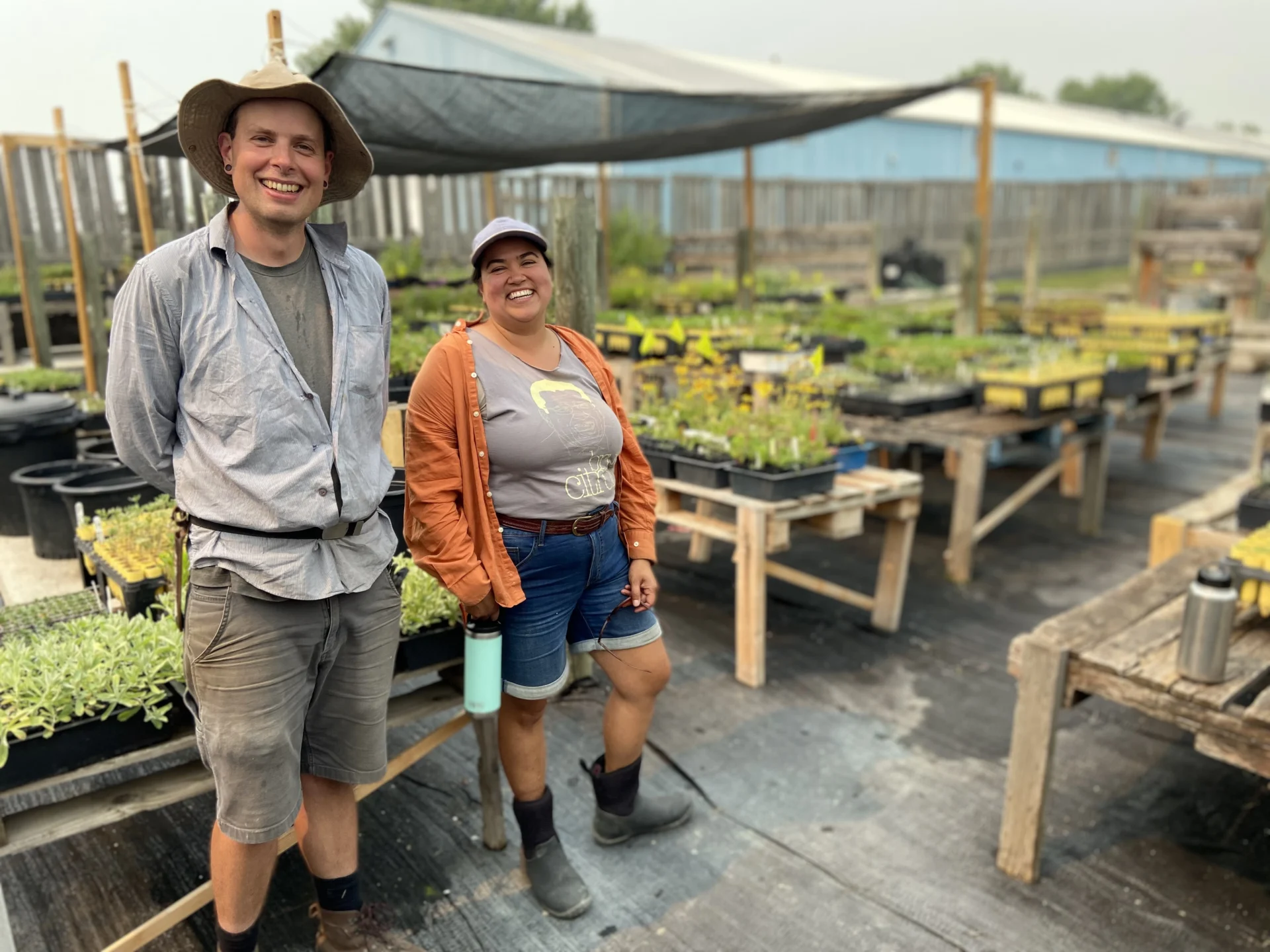
Latifa Pelletier-Ahmed holds a BSc in botany from the University of Calgary and an MSc in herbal medicine from Middlesex University in London. Ben Hartney is a Red Seal landscape horticulturist trained at Olds College. Together, they have built a nursery operation that connects grassland conservation to the marketplace — growing and selling native plants and source-identified seed to retail customers, private landowners, landscapers, municipalities, counties, parks, and restoration projects across Alberta.
But the foundation of everything they do is the grassland itself.
“Without native grasslands, there is no foundation for the work we do,” Latifa says. “Even a small remnant can be extraordinarily valuable.”
Seed by Seed, Season by Season
The ALCLA year begins in January, in the greenhouse, when the rest of Alberta is still buried in winter. Native plants are not easy to propagate. Many species have complex dormancy requirements — some need cold stratification, others scarification, others a very specific sequence of conditions before they will germinate at all. Learning what each species needs takes years of trial, observation, and patience. 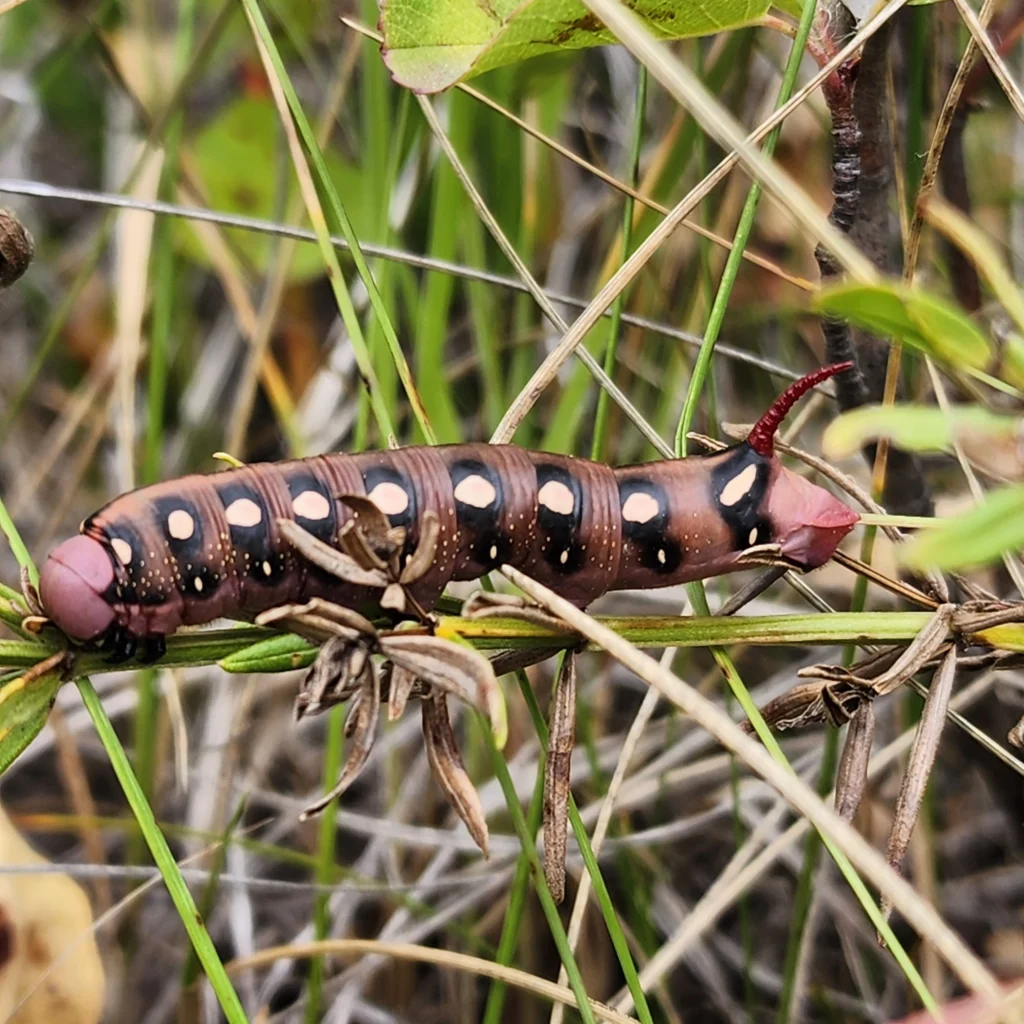
Latifa and Ben stratify seed, scarify seed, sow by hand, transplant seedlings into plugs, grow them on, harden them off, and begin moving plants outside by mid-to-late April when conditions allow. Live plants are sold from May through the end of September. Seed is sold year-round.
Seed collection begins earlier than most people expect — in June, when Prairie Crocus and Prairie Smoke ripen and must be collected before the window closes. The bulk of collection happens in late summer and fall, stretching into October and November for species like Silver Sagebrush and Rubber Rabbitbrush.
They collect wherever they are legally and ecologically able to: roadsides, rights-of-way, public land, private land with permission. They also receive seed gifted from First Nation reserve lands, including Kainai and Siksika, and they extend that relationship in return — donating Prairie Sage and Sweetgrass plants to the Aboriginal Friendship Centre of Calgary, and supporting Api’soomaahka, William Singer III, a Kainai Nation member of the Blackfoot Confederacy, through gifts of Sage and Sweetgrass clippings, plants, and seeds for Naapi’s Garden.
“These plants are part of living relationships,” Latifa says. “Supporting their presence is part of being good treaty partners.”
Their sourcing extends as far north as Edmonton and as far south as the Montana border, across Parkland, Mixedgrass, and Fescue Grassland regions. Because ALCLA specializes in source-identified seed — material traceable to specific wild populations — what they are really selling is genetic integrity. Locally adapted plants, grown from seed that belongs to this landscape.
What the Grassland Costs
None of this is simple work. Latifa describes driving hours to collect a target species, only to find it already grazed by cattle. Red Paintbrush — a favourite forage plant — can be eaten before it sets seed, season after season, until it quietly disappears from a site. She has found Common Tall Sunflower with its flower heads eaten through a barbed wire fence by livestock that stretched their necks for the blooms.
“If a plant is repeatedly grazed before seed set, it gradually loses its place on the landscape while more grazing-resistant species become dominant,” she explains. The change is slow and cumulative and easy to miss — until the species is simply gone.
Invasive plants press in at the edges. Wormwood and Canada Thistle move into disturbed areas and compete aggressively with native plants. Ground squirrels — important prairie animals, Latifa is careful to note — caused significant losses in a new field planting last fall. She and Ben have been experimenting with non-toxic deterrents while trying to respect that wildlife also belongs on this land.
Access is another constraint. Much of Alberta’s remaining native grassland sits on private land or in places difficult to reach. Some species are harder to steward simply because they are harder to find.
And underneath all of it is the challenge of propagation research. Learning to grow native plants through cultivation — without drawing too heavily on wild stands — takes years of costly, careful experimentation. Some species resist conventional techniques entirely.
This is why land conservation, Latifa says, remains the most essential tool of all.
The Moth and the Mystery
The hawk moth story has a sequel.
After that evening watching the primrose, Latifa came across a documentary about the Western Prairie Fringed Orchid — one of the rarest orchids in North America, with the largest remaining population now in southern Manitoba. The film described the Bedstraw Hawk Moth as one of the orchid’s key pollinators: a specialist relationship, shaped by the orchid’s exceptionally long floral tube, evolved over millennia to match the moth’s proboscis.
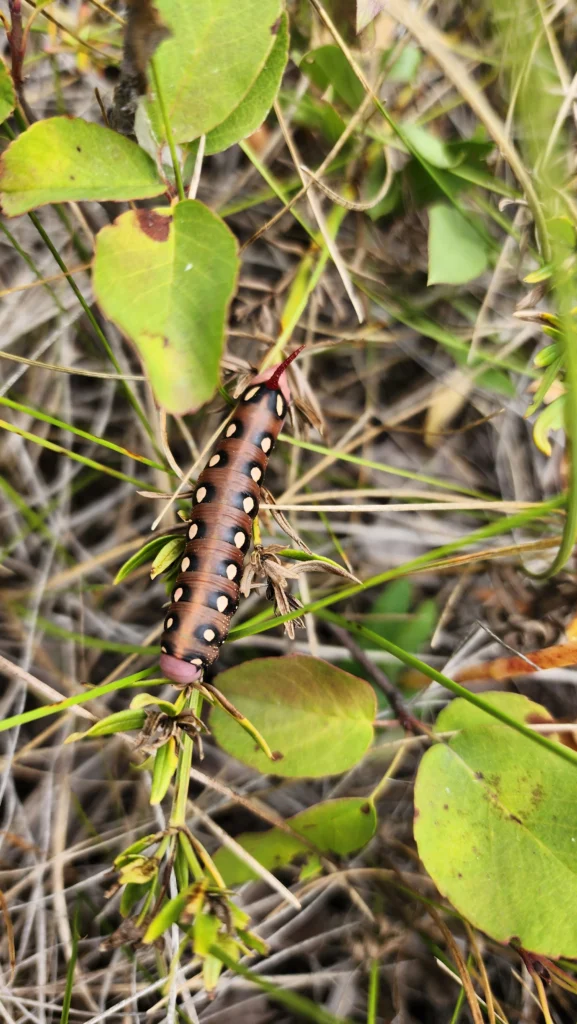 It reframed everything she had witnessed that night. The moths were not random visitors. They were participants in something ancient and precise — a co-evolutionary relationship requiring both the insect and the plant to persist, in proximity, across generations.
“That deepened the experience for me,” she says, “because it reminded me how specialized some of these relationships are and how much depends on intact grassland systems continuing to exist.”
There is a second insect story, equally striking. From seed collected near Drumheller, ALCLA grew out plants of Hoary Aster — a native prairie composite with small, pale-rayed flowers. On those plants, they found caterpillars of the owlet moth Cucullia dorsalis: ornately patterned, charismatic creatures whose markings Latifa describes as resembling beadwork. She posted the observation to iNaturalist, the citizen science platform for biodiversity recording, and discovered that this was an unusually far-west sighting — and that the records showed a strong association between this moth and this specific plant.
The caterpillars had arrived on their host plant 100 kilometres from where the wild native stands grew. How they found it remains, as Latifa puts it, a mystery.
“There is still so much we do not know about native insect-plant relationships,” she says. “Moments like that make the grasslands feel full of mysteries still waiting to be understood.”
Roots in the Land
The path that brought Latifa and Ben to this work runs through family, across continents and generations.
On her mother’s side, Latifa’s grandfather was a pioneer settler in the Parkland Prairie of northern Alberta, where the family had a close relationship with the land — a relationship that outlasted the conversion of much of that prairie to cropland. On her father’s side, her grandfather in Bangladesh was a botanist. She did not know either of them well. But the love of plants and attentiveness to the land carried down through the family and found its way to her.
For Ben, it began with his mother’s garden — vegetables and fruit, the smell of soil, a childhood shaped by proximity to growing things. That early closeness to the earth eventually led him through community gardens to professional horticulture and, finally, to this.
Two people shaped by different landscapes, both drawn to the same stubborn, hopeful work: restoring what remains, building what’s possible, passing the seed forward.
An Invitation
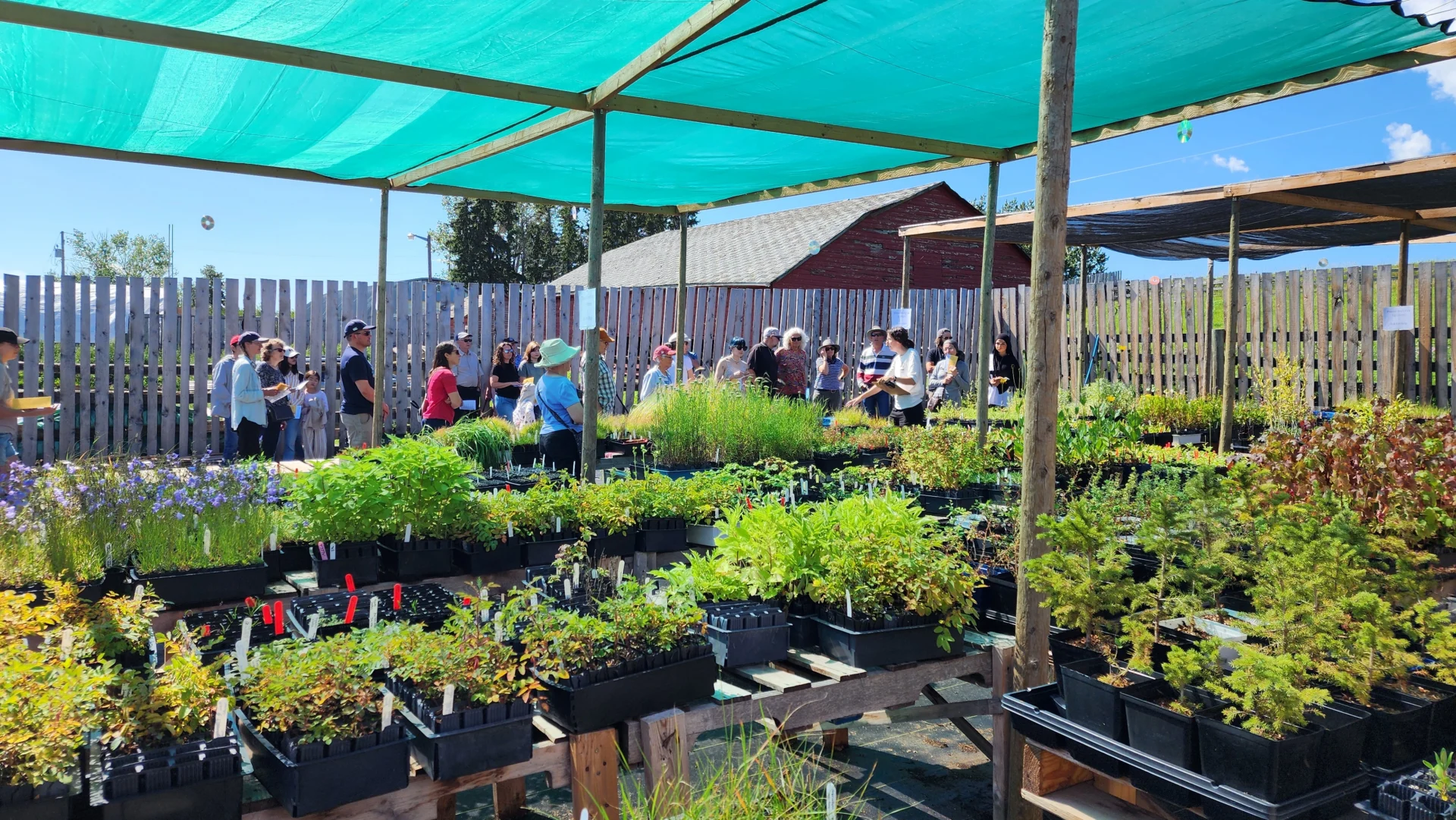
Visitors to ALCLA Native Plants during Alberta Open Farm Days on August 15–16, 2026 will have the chance to walk the land, see the nursery operation, and learn directly from Latifa and Ben about what native plants are, why source identification matters, and what it actually looks like to steward a piece of Alberta grassland.
They may not see a hawk moth. But they will leave knowing what to look for.
Follow them on Facebook here: facebook.com/albertanativeplants
Visit albertaopenfarmdays.ca to find ALCLA Native Plants and plan your visit.
#AlbertaOpenFarmDays #OpenFarmDays2026 #ABOpenFarmDays #AlbertaAg