
Grass Looks Simple. It’ll Teach You Different.
There’s a saying out on the Alberta prairies that the land always tells the truth. At Toews & Bale, they’ve staked an entire operation on listening to it.
Pam and Warren Toews didn’t inherit a farm. There was no land passed down, no equipment waiting in the yard, no generations of know-how to pull from when things got hard. They started from scratch, made their decisions one season at a time, and built something worth building — a working hay operation rooted in tame pasture, cultivated grasslands, and a relentless commitment to doing things better.
In 2026, as the world recognizes the International Year of Rangelands and Pastoralists, their story is exactly the kind that deserves to be told.
The Grass Is the Business
Toews & Bale produces small square hay bales — timothy, alfalfa, and orchard grass — grown specifically for high-performance horses. It’s a niche market, and it demands precision. The right mix means lower sugar, higher protein, and a product that horse owners can trust. Getting there means paying close attention to what the fields are telling you, long before a single bale gets stacked.
Their land cycles through a rotation of annual crops like cereal grains and peas before being seeded back into hay, where it stays for seven to eight years at a stretch. It’s not native prairie in the traditional sense, but it’s working prairie in every way that matters. Managed, intentional, and treated with the respect that productive land deserves.
“Grass looks simple,” Pam says, “but it’ll teach you pretty quick if you’re paying attention. We’ve built our whole life around learning how to work with it.”
A Full-Time Relationship With the Sky
Ask anyone on a hay operation what the hardest part of the job is, and the answer is almost always the same: weather.
At Toews & Bale, summer means living and dying by the forecast. Cut too early and the weather turns. Wait too long and the window closes. Rain at the wrong moment can take a near-perfect crop and strip most of its value in an afternoon. There’s no app that changes that. There’s no workaround. You learn to watch, adapt, and move fast when the conditions line up.
“We spend a lot of time watching the weather and pretending we can do something about it,” Pam jokes. But beneath the humour is something real — a deep understanding that farming means working within nature’s timeline, not around it.
Spring is about growth and assessment. Summer is go-time, long days, no questions asked. Fall is about finishing what was started and preparing the land to rest. And winter? That’s when they fix what broke, rethink what didn’t work, and plan for next year.
“Out here,” Pam says, “the work is real, the seasons are honest, and the land always tells the truth.”
When What You Need Doesn’t Exist, You Build It
One of the most compelling threads in the Toews & Bale story isn’t just about grass — it’s about ingenuity.

Being a first-generation farm meant there was no blueprint to follow. Early on, Pam and Warren made a deliberate choice: instead of expanding their land base, they’d focus on getting more out of the acres they already had. That decision pushed them toward creativity in a big way, particularly when it came to equipment.
Warren and his dad began developing their own machinery right on the farm — including the Triple Hitch and a custom re-baler system — because the tools they needed either didn’t exist or simply didn’t work well enough for how they operate. Each build started the same way: a long day in the field, a problem that kept coming up, and the thought that there had to be a better way.
So they’d head to the shop. Try something. Test it. Tweak it. Try again.
That process is still going. It’s not a phase they went through — it’s become part of the farm’s identity.
Building Something That Lasts

Toews & Bale may be a first-generation operation, but Pam is quick to point out that doesn’t make the story any shorter — it just means they’re writing the early chapters.
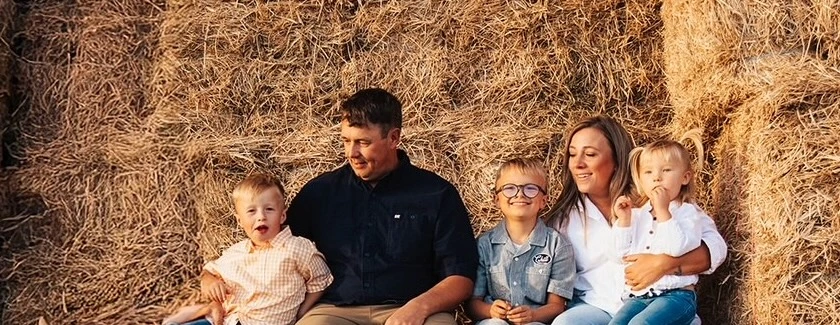
The family works together. The kids are growing up understanding that good things take time, effort, and a bit of grit. The land they farm is shaping them just as much as they’re shaping it.
In a year dedicated to celebrating rangelands, grasslands, and the people who steward them, Toews & Bale is a reminder that you don’t need generations behind you to have something meaningful to pass forward. Sometimes the most important traditions are the ones you’re building right now.
“You can’t rush hay,” Pam says with a smile. “We’ve tried.”
Toews & Bale is a participating farm with Alberta Open Farm Days. To learn more about their operation and find more of their stories, visit haybales.ca. Join us August 15–16, 2026 for Open Farm Days across Alberta — find farms, plan your visit, and connect with the people who grow your food at albertaopenfarmdays.ca.